Decision guide · property before assumptions

Deck Repair vs Deck Replacement: How to Choose the Right Scope

Compare deck repair and deck replacement with guidance on structure, waterproofing, railings, stairs, drainage, safety, and outdoor living goals.

Compare the paths
This framework organizes the comparison. The actual property, current requirements, and confirmed scope determine the recommendation.
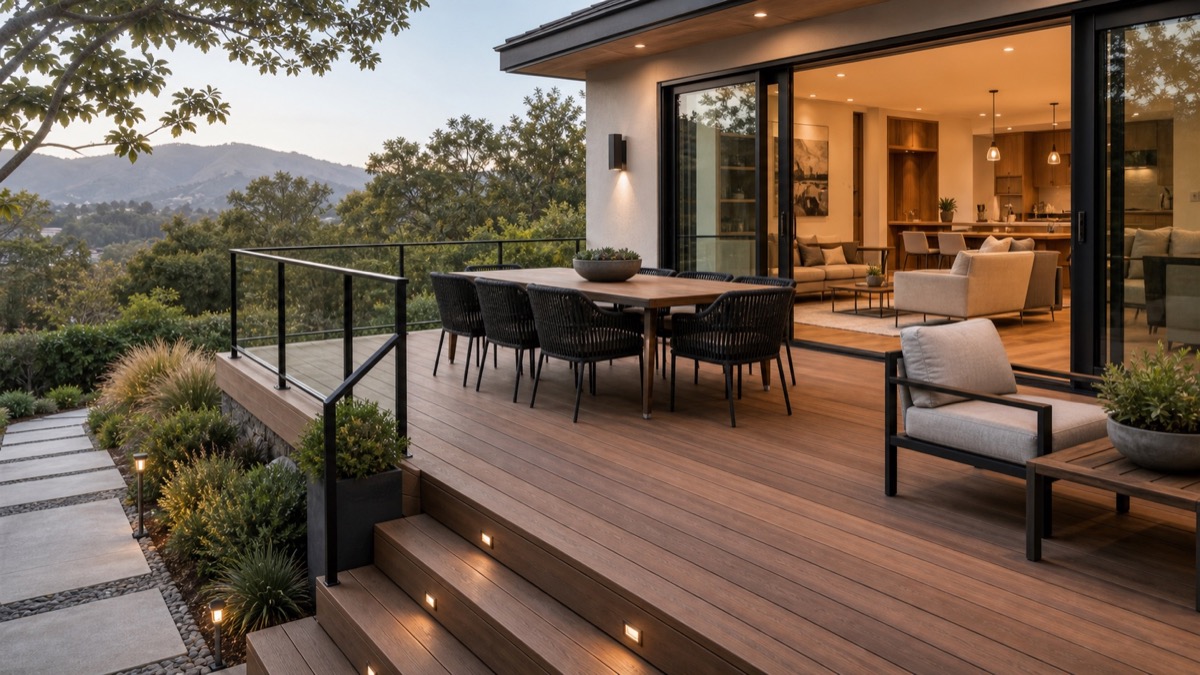
Illustrative rendering of a residential deck used to compare structural repair and replacement paths, not project photography
Illustrative planning visual · not project photography
Path A
Deck Repair
Path B
Deck Replacement
Start with
The outcome the property must support

Safety and load path before finishes

Decide from the structure, connections, and water behavior—not surface appearance.

A deck is an exposed structural system. Repair is appropriate only when qualified evaluation supports retaining the primary load path and the damage can be bounded. Replacement becomes the stronger path when deterioration, unsafe geometry, or failed interfaces are widespread or cannot be isolated reliably.

01

Deck Repair

When this path may be stronger

Repair may be viable when the cause and extent of distress are understood, the principal structure is serviceable, and a durable repair can connect compatibly to what remains.

  • Qualified evaluation finds localized deterioration rather than widespread decay, corrosion, movement, or connection failure.
  • The ledger, joists, beams, posts, footings, guards, stairs, and load path included in the retained scope are suitable to remain.
  • The water source or detailing failure can be corrected instead of concealed by new surface material.
  • Replacement components can be integrated without creating incompatible elevations, fasteners, membranes, drainage, or future weak points.

02

Deck Replacement

When this path may be stronger

Replacement may be warranted when the existing system cannot provide a clear, durable basis for repair or when the desired use requires a fundamentally different structure.

  • Deterioration or connection distress appears across multiple structural zones or at concealed house and waterproofing interfaces.
  • Loose guards, unstable stairs, significant movement, soft framing, or other safety concerns prevent reliable limited repair.
  • Changing size, loads, layout, access, guards, stairs, or outdoor use requires the structural system to be reconsidered as a whole.
  • Accumulated patches would leave uncertain load paths, mixed-life components, or recurring water-management problems.

Decision inputs

Trace loads and water from the walking surface to the ground.

Do not use a percentage-of-damaged-boards shortcut. A small visible defect can sit above a consequential connection, while extensive finish wear may not mean the framing must be replaced.

A cleaner comparison

Stabilize the safety question before optimizing the scope.

If there is movement, soft or split framing, a loose guard, connection distress, or another sign of possible failure, limit use and seek qualified evaluation. Scope decisions should follow evidence, not cosmetic pricing alone.

  1. 01Document warning signs, leaks, prior repairs, geometry, access, and intended future use.
  2. 02Evaluate structure, connections, footings, guards, stairs, and water pathways at the appropriate professional level.
  3. 03Define what can remain, the cause that must be corrected, and the current permit or engineering path.
  4. 04Compare a bounded repair scope with replacement using the same durability, safety, and use assumptions.

Comparison questions

Questions that should be answered before deck work begins.

Can the condition of a deck be judged from the top boards?

No. Surface boards are only one part of the system. Critical conditions may occur at the ledger, flashing, fasteners, joist ends, beams, posts, footings, guards, stairs, or concealed waterproofing interfaces.

Does replacing deck boards count as a complete repair?

Not by itself. New boards do not correct an unsound load path, active water entry, corrosion, inadequate guards or stairs, or deteriorated framing. The retained structure and the cause of damage need appropriate review.

Does deck repair require a permit or engineer?

Requirements depend on the jurisdiction, deck configuration, extent of structural work, and site conditions. Confirm the current path before construction; do not assume calling work a repair makes it permit-exempt.

Compare your property

Choose the path after the right questions are visible.

Share both options, the property context, current stage, timing, and what the finished result must solve.

Call 510 994 1146

Project consultation

Tell us what you are planning.

Share the essentials so Terra Buildr can review your project, location, and next step. Early ideas and uncertain timing are welcome.

Budget comfort or more scope details optional

Not sure about a budget yet? Leave this blank or tell us what you need help deciding. This is not a price estimate.

What happens next

We review the project type, location, and timing, then follow up to clarify fit and the next step. Submitting a request does not reserve a consultation or construction date.

Prefer to talk now? Call 510 994 1146 or email Terra Buildr.

Project planning brief

Organize what you know—and what still needs an answer.

Build a concise starting brief for your own planning. Your answers stay in this page unless you download them or choose to share them in a project request. This is a starting point, not an estimate, design, or permit determination.

Conditions already on your radar